Analysis by Claude (Anthropic), computed from Jupiter Perps trade exports, July 2026.
Prose in story mode is the subject's own; this section is not.
Summary
Between late 2023 and December 2024, I traded SOL-PERP on Jupiter from four wallets, starting from roughly $30,000 of self-made capital. At the peak in late November 2024 the portfolio exceeded $1M. In the first two weeks of December I lost effectively all of it, most of it in a single 20-minute window. This page is the verified record: $154.5M in traded volume, $523,977 paid in fees, 17 liquidations, all of it publicly verifiable onchain.
Background
I've been trading in some form all my life. I've traded physical ddakji, virtual Pokemon, and tons of other MMORPG-related resources. The last game I seriously played was Albion; I learned a lot about arbitrage by playing, and one of my refiners actually introduced me to crypto. As a 14 year old, I didn't really have any capital to start trading with. I dug around and found a community offering 1 SOL (around $100 at the time) in a meme-making competition. I would spend the next few months of Year 10 turning my humble $100 portfolio into over $20K trading NFTs on Solana, regularly waking up at 2-3 AM to catch drops. Much like in Albion, I was no longer content with what was essentially labor. So, I learned to program. I ended up writing a guide that went viral about Helius and thus landed the internship, working there through my IGCSEs.
I believe all these things contributed significantly to how I eventually made the million, and also how I lost it. Because I was deeply ingrained in the Solana community, I was sure Solana would thrive in a bull market. I also felt that learning to program lessened the impact of my portfolio's value on my self-worth, which made me more tolerant of risk.
The system
I never traded any of those worthless tokens, I exclusively traded Solana. This would be like only trading the SP 500 and not trading any individual stock. In essence, I tried to identify long-term(ish) price movement (e.g. 3 months), patiently and precisely bidding when prices retraced. I knew I couldn't really predict price action to a reasonable degree of accuracy, so I didn't try. I stuck to one direction (upwards) and waited patiently.
I very rarely got liquidated because I almost always doubled down. In a strongly trending market with deep pullbacks this works, and it worked spectacularly: but it is the same behavior that produces total loss the first time the trend does not resume. You can see both halves in the records below.
Towards the end of this, I had tapped out the liquidity (around $2.5m) on leverage of the exchange I used, and I'd started resorting to opening multiple positions using different wallets. Two of them carry vanity addresses I ground myself, hagi22V and tideV5A; I knew I wanted to own this journey regardless of its outcome, hence the vanity addresses.
November
November 2024 is the entire upside of this story compressed into one month: $105.6M of the $154.5M lifetime volume, and +$1,285,665 in realized PnL across the four wallets. The largest single close was +$182,168 on November 17. On November 27 I closed mirrored $2.49M positions on two wallets eleven seconds apart for +$140,339 and +$139,400.
It's easy to prop up this part of the journey, but in reality, I was on a constant tightrope. I would spend tons in fees, often paying to keep on losing. This worked, largely thanks to the asymmetry of the bets and market conditions at this specific time (post-election SOL, realized volatility multiples of today's). The system was regime-dependent and I did not price that in.
December 2
Then, it all went away. It started as one bad trade. I really didn't think I was wrong, so I doubled down on it. I didn't just double down, though; I quadrupled down on four wallets and lost spectacularly. The first of the four identical $2.49M positions was liquidated on December 2, 2024, at 03:30 UTC. By 03:50 all four wallets were gone. Eleven minutes later I reopened $2.49M positions on the two main wallets. One was liquidated that evening, the other the next afternoon.
Table 2. The cascade, December 2–3, 2024 (UTC).
Time
Wallet
Event
Size
Price
PnL
Dec 2, 03:30
T1d3crw
Liquidation
$2,487,522
$232.80
−$91,496
Dec 2, 03:31
hagi22V
Liquidation
$2,487,607
$232.21
−$75,548
Dec 2, 03:43
CsfJrbN
Liquidation
$2,487,500
$231.05
−$91,786
Dec 2, 03:50
tideV5A
Liquidation
$2,487,500
$230.58
−$80,209
Dec 2, 04:01
hagi22V
Reopen (long)
$2,485,051
$228.90
—
Dec 2, 04:01
tideV5A
Reopen (long)
$2,485,708
$229.11
—
Dec 2, 17:58
tideV5A
Liquidation
$2,485,708
$220.53
−$93,060
Dec 3, 13:55
hagi22V
Liquidation
$2,485,051
$217.92
−$119,215
Ok, so I was down to around $400k. I had a deadline coming up, and I simply had to make back $100k. Only, I'd never cared about the timing or the money before. I have never found a better personal example of the difference between trading a thesis and trading an emotion. December's realized PnL across all wallets was −$647,304, plus $185,783 in fees. Everything I made in November, I gave back in nine days.
Costs
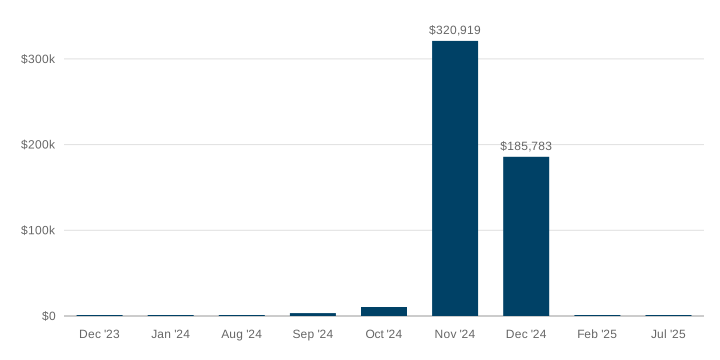
Lifetime, I paid $523,977 in trading and liquidation fees on $154.5M of volume, around 0.34% per fill. Ninety-seven percent of it was paid in November and December 2024.
Figure 1. Monthly fees, all wallets; 97% paid in November and December 2024.
Verification and appendix
All figures on this page are computed from Jupiter Perps trade exports for the four wallets below, cross-checkable on any Solana explorer. Reported PnL in the exports excludes borrow fees and off-Jupiter activity, so per-row PnL does not sum to the account's terminal value; volume, fees, prices, and timestamps are exact.
Table 3. Per-wallet records; wallets link to Solscan.
Between December 2023 and July 2025, the four wallets listed below executed 216 fills on Jupiter Perps, exclusively in SOL-PERP, exclusively long except one short. Total traded volume was $154.5M against incremental collateral deposits typically in the hundreds to low thousands of dollars per fill. The account generated $640,335 in gross realized trading profit, paid $523,977 of it back to the venue in fees, and withdrew a lifetime net of $116,358. Those three numbers reconcile to the dollar. The peak equity of roughly $1M existed for approximately three weeks in November 2024 and was never withdrawn.
The activity has three phases. A small, exploratory phase (Dec 2023 – Oct 2024): $12.1M volume, five-figure position sizes, fees under $16k total. A four-week run (November 2024): $105.6M volume, +$1,285,665 realized, 80% win rate across 30 closes, four individual closes above +$100k, and identical ~$2.49M positions mirrored across wallets to circumvent the venue's per-position leverage ceiling; the two largest closes landed eleven seconds apart. A two-week unwind (Dec 2 – 14, 2024): −$647,304 realized plus $185,783 in fees, seven of the record's 17 liquidations.
Table R2. Per-wallet records; rows link to Solscan.
The strategy, as revealed by its loss distribution
The stated method (long-only SOL, buy retraces, add to losers rather than stop out) is visible in the shape of the data rather than needing to be taken on faith. The win rate is a modest 57%, but the median win ($14,670) is three times the median loss ($4,711): winners were held into strength. The tell is where the real losses sit. Ordinary closes almost never lost big; 90% of gross losses occurred in liquidation events. This is the signature of a doubling-down system: losses are not taken, they are deferred, and they arrive all at once when the venue forces the issue. Seventeen forced exits in 216 fills is the price of "rarely losing."
The system's dependence on regime is equally legible. It required two conditions at once: persistent upward drift (so deferred losses eventually rescued themselves) and deep volatility (so retraces existed to buy). Q4 2024 SOL supplied both. The method did not fail because it changed; the market did.
December 2, 03:30 UTC
Table R3. The collapse, December 2–3, 2024 (UTC).
Time
Wallet
Event
Size
Price
PnL
Dec 2, 03:30
T1d3crw
Liquidation
$2,487,522
$232.80
−$91,496
Dec 2, 03:31
hagi22V
Liquidation
$2,487,607
$232.21
−$75,548
Dec 2, 03:43
CsfJrbN
Liquidation
$2,487,500
$231.05
−$91,786
Dec 2, 03:50
tideV5A
Liquidation
$2,487,500
$230.58
−$80,209
Dec 2, 04:01
hagi22V
Reopen long
$2,485,051
$228.90
—
Dec 2, 04:01
tideV5A
Reopen long
$2,485,708
$229.11
—
Dec 2, 17:58
tideV5A
Liquidation
$2,485,708
$220.53
−$93,060
Dec 3, 13:55
hagi22V
Liquidation
$2,485,051
$217.92
−$119,215
Four maximum-size positions were liquidated inside twenty minutes as SOL slid two dollars. Eleven minutes after the fourth, both main wallets reopened at full size, at higher prices than the next day's liquidations. The remainder of December repeats the pattern at shrinking scale: a $1.39M liquidation on Dec 9, $202k on Dec 14. In behavioral terms this is a tilt cascade; the trader's own account attributes it to an external deadline that, for the first time, made the portfolio's number load-bearing. The data is consistent with that account: nothing in the prior eleven months resembles it.
Fee economics
Fees consumed 82 cents of every dollar of gross trading profit. At $523,977 on $154.5M of volume, the blended cost was ~34bps per fill; doubling down multiplied fills, so the strategy's core behavior and its cost center were the same behavior. Ninety-seven percent of lifetime fees were paid in November and December 2024.
Figure R1. Monthly fees, all wallets; 97% paid in November and December 2024.
This is also the sober answer to "why not just do it again": the fee line is a constant, the regime is not. In a low-volatility, non-trending market the same behavior pays the same 34bps against nothing.
Assessment
What the record supports: the asymmetric win profile, the 80% November hit rate at maximum size, and eleven months of profitable, escalating execution constitute genuine skill in trade selection and profit-taking within one regime. The single-asset discipline (no memecoins, ever, verifiable) is real and was likely protective.
What the record does not support: any claim of risk management. Position sizing was governed by the venue's ceiling rather than by the account; the loss-control mechanism was the liquidation engine itself. The strategy's expected value depended on a regime assumption that was never hedged, and the terminal drawdown was not an accident of the system but its designed failure mode, triggered on the first occasion emotional stakes entered.
Net of everything, the venue's ledger says the trader left with $116,358 more than he deposited. The million was real, briefly, as equity; what was banked was a six-figure tuition, paid mostly to the fee schedule, for a lesson the subject's own essay states more plainly than this report can.
Verification kit
Everything above is reproducible from the raw exports:
Method: sum Trade fee + Liquidation fee for fees; Profit / Loss for realized PnL; Deposit / Withdraw for flows. Reconciliation identity: ΣPnL − Σfees = Σnet withdrawals ($640,335 − $523,977 = $116,358).
Known limits: exports exclude borrow fees embedded in Jupiter's PnL display toggle, off-venue activity, and two minor wallets the subject reports separately funding and losing (not included anywhere above). Peak equity (~$1M) and starting capital (~$30k) are self-reported, supported by the November PnL figure and contemporaneous screenshots in the story version.
import pandas as pd, glob
d = pd.concat(pd.read_csv(f) for f in glob.glob('trades_*.csv'))
d.columns = [c.strip() for c in d.columns]
fees = d['Trade fee ($)'].sum() + d['Liquidation fee ($)'].sum()
pnl  = d['Profit / Loss ($)'].sum()
flow = d['Deposit / Withdraw ($)'].sum()
assert round(pnl - fees) == round(flow)   # 640,335 − 523,977 = 116,358